The Self-Care Lie They Keep Selling to Caregivers
Someone is going to tell you to take a bath.
Maybe it's an article. Maybe it's a well-meaning friend. Maybe it's a therapist who means well but has never tried to schedule their own emotional breakdown around a parent's cardiology appointment. Somewhere in your caregiving life, someone is going to hand you a candle, point at a bathtub, and suggest that this is the solution.
It isn't.
The Self-Care Industrial Complex
There's a whole industry built around the idea that you can restore yourself through personal choices — sleep routines, meditation apps, journaling prompts, green juice. It's not entirely wrong. Rest matters. Nutrition matters. But the advice gets weaponized against caregivers in a way that's almost cruel.
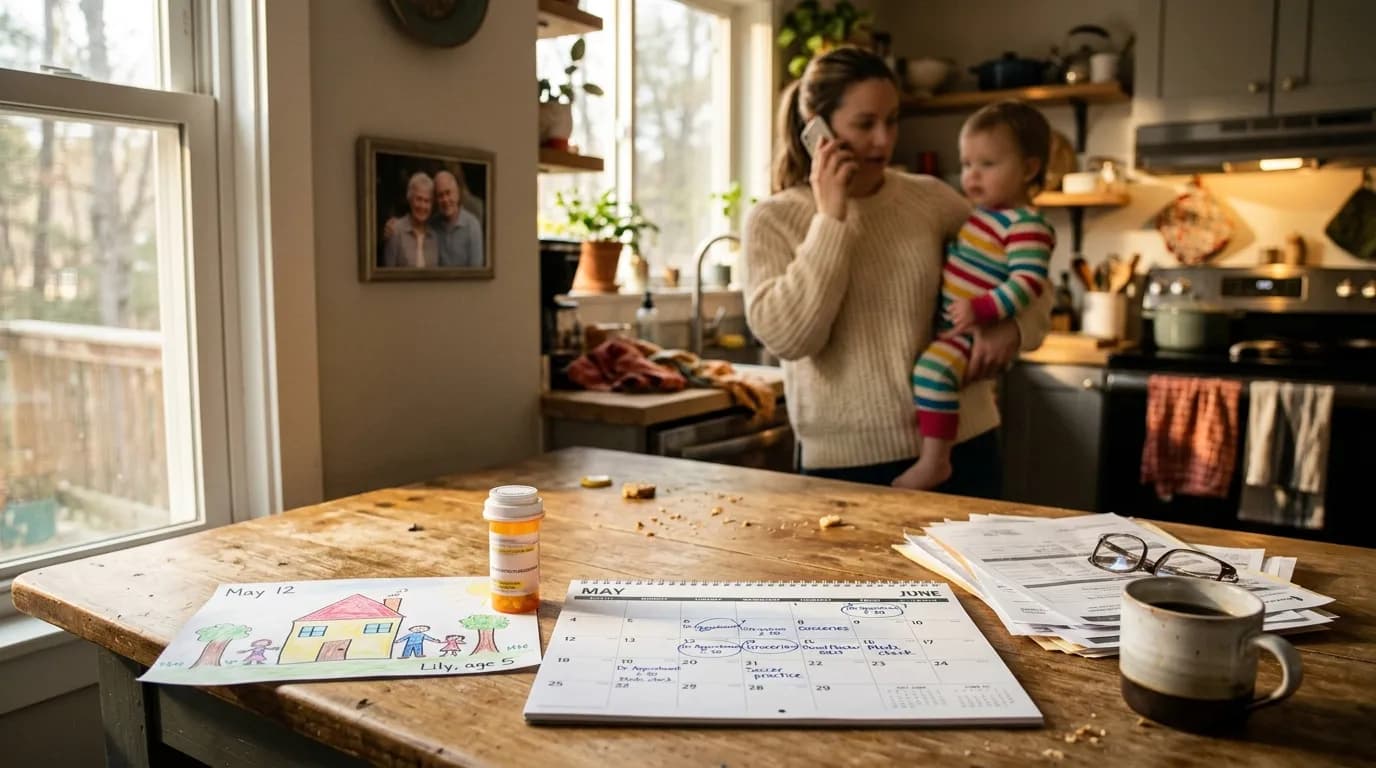
When you're managing a parent's doctor appointments, medication schedule, insurance calls, and daily needs — often while holding down a job and raising your own family — being told to "prioritize yourself" lands like a joke with no punchline. You know you're running on empty. You didn't need a magazine to tell you that.
What the self-care industry sells is the idea that your exhaustion is a personal problem, one that could be solved if you just made better choices. Sleep more. Exercise. Eat well. Take time for yourself.
The implication is clear: if you're depleted, it's partly your fault for not taking better care of yourself.
That framing is wrong. And it's worth getting a little angry about it.
What You're Actually Doing
Here's the part nobody says out loud enough: you are performing labor that entire social systems are supposed to support and don't.
Caregiving for an aging parent — bathing them, managing their medications, navigating their insurance, driving them to appointments, being the person they call at 2 a.m. — is a job. It's unpaid, largely invisible, and carries enormous physical and emotional weight. In countries with robust elder care infrastructure, that work is shared across professional care workers, community programs, and public systems. In the United States, it falls almost entirely on families. Usually on one person in the family. Often on a woman.
When you're doing a job that a community of professionals is supposed to share — and doing it alone, without training, without compensation, and without a clear end date — the problem isn't your sleep routine.
The problem is the structural absence of support. And no bubble bath is going to fix that.
The Guilt on Top of the Exhaustion
One of the crueler ironies of the self-care message is what happens when caregivers can't follow it. You're already exhausted. You're already running past your limits. And then you read that you're supposed to be exercising and sleeping and meditating, and you're not doing those things, and now you feel like a failure on top of everything else.
The guilt compounds the exhaustion. The exhaustion feeds the guilt. It becomes a loop with no exit, and somewhere in the middle of it you're also just trying to remember if your mother took her 8 a.m. pill.
So let's reframe something important: you're not failing at self-care. You're succeeding — wildly, imperfectly, messily — at an impossible job. The fact that you're showing up every day, even when you don't want to, even when you're furious, even when you're grieving someone who's still alive, is something. It's actually something big.
White-knuckling it through a hard thing still counts. More than it gets credit for.
What Actually Helps
This isn't a case against rest or care for yourself. Rest is real. It matters. The issue is when personal choices are framed as the solution when the real need is structural support.
What actually moves the needle for most caregivers:
Connection with other caregivers. Not advice, not tips — actual human contact with people who understand what this is like. Caregiver support groups (in-person and online) consistently show up in research as one of the most effective interventions for caregiver wellbeing. Being understood matters.
Concrete relief of cognitive load. The mental inventory of caregiving — tracking every appointment, medication, insurance deadline, and logistical detail — is its own form of exhaustion. When some of that load gets offloaded to a system rather than held entirely in your head, it creates room to breathe. Not spa-day relief. Actual functional relief.
Asking for specific help. Caregivers are notoriously bad at asking for help and accepting it when offered. The research on this is clear: people want to help but don't know what to do. "Can you bring dinner Thursday?" lands. "Let me know if you need anything" disappears into air.
Acknowledging what you can't control. Caregiving involves an enormous amount of uncertainty — uncertainty about health trajectories, about family dynamics, about the future. Learning to hold that uncertainty without being destroyed by it is a skill, and it's not one you get from a face mask.
The Permission Slip You Actually Need
You don't need permission to be imperfect. You're already imperfect, and you're still showing up. That's the whole thing.
What you need is for someone to acknowledge that you're doing something genuinely hard — not hard in a "well, everyone struggles" way, but hard in a "this would break most people" way. You're navigating a system that wasn't built for you, carrying a load that was never meant to be carried alone.
So the next time someone hands you a self-care tip: take what's useful, leave what isn't, and know that the reason you're depleted isn't a personal flaw.
It's an honest response to an unreasonable situation.
Managing care for an aging parent?
TendTo helps families coordinate medications, bills, appointments, and documents in one shared dashboard.
Start Free