The Day You Can't Leave Anymore
You noticed it around the edges first. The stove left on. The door left unlocked. The medication sitting untouched in the blister pack on a Wednesday when she swore she'd taken it.
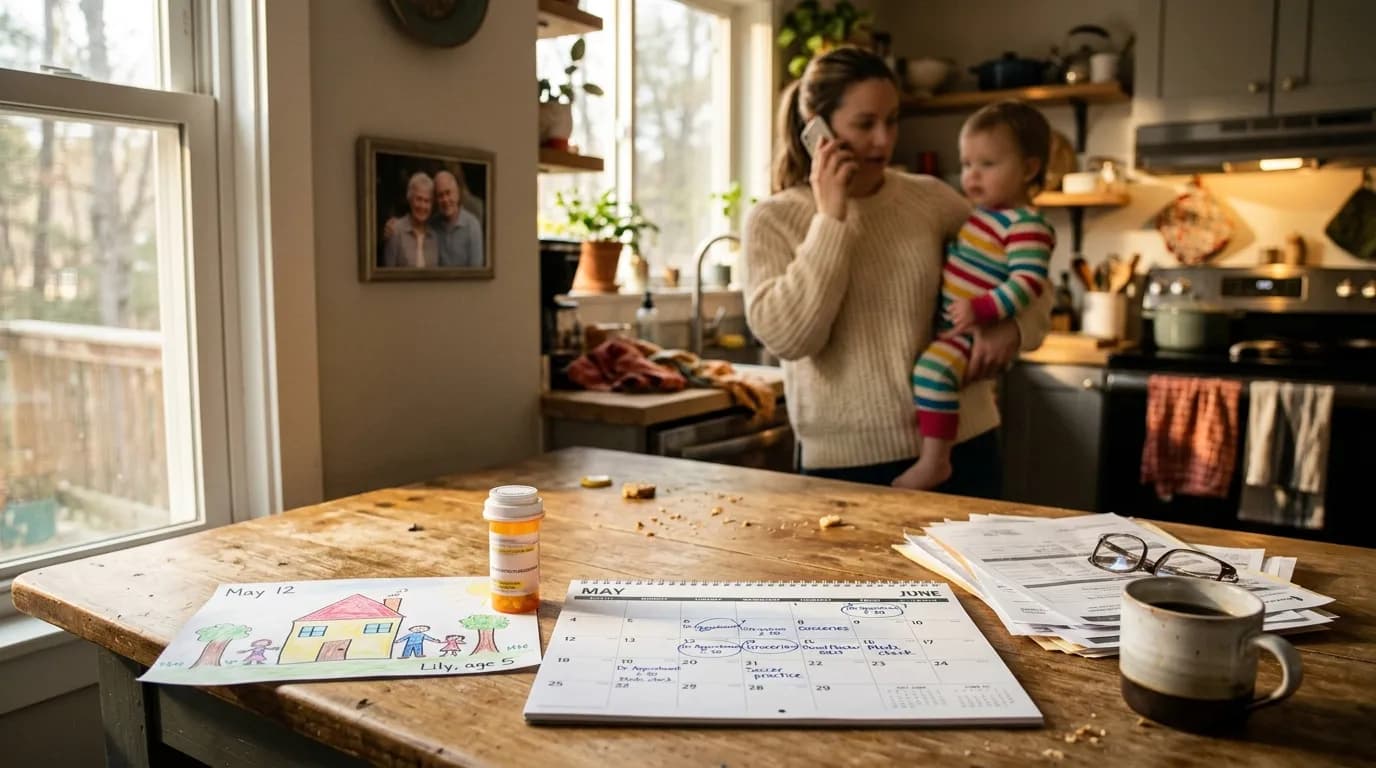
You started calling twice a day instead of once. You started dropping by on your way home from work "just to check." You started holding your breath from the moment you said goodbye until the moment you heard her voice again.
And then one day — maybe it was a specific incident, maybe it was just an accumulation — you did the math and realized you could no longer leave her alone. Not safely. Not really.
That moment changes everything.
The Safety Calculation Nobody Walks You Through
There's no formal protocol for this transition. No doctor hands you a checklist. No social worker shows up and says, "Based on these criteria, your parent requires 24-hour supervision." It usually falls to the family caregiver to make the call, often alone, often based on fear as much as evidence.
But there are real risk factors worth thinking through clearly:
Cognitive decline and wandering risk. Once a person with dementia begins to wander — or shows signs that they might — being alone is genuinely dangerous. People with dementia can exit a home in minutes, in any weather, in any state of dress, and have no reliable sense of how to get back. This single factor, for many families, is the tipping point.
Falls. After an adult falls once, their risk of falling again roughly doubles. Falls are the leading cause of injury death in adults 65 and older. If your parent has fallen — especially if they couldn't get up on their own — the question isn't just whether they'll fall again, but what happens when they do and nobody's there.
Medication mismanagement. Missing doses of cardiac medication, blood thinners, or insulin isn't an inconvenience. It can be a medical emergency. If your parent cannot reliably manage their own medication — and many cannot, even those who seem generally competent — being alone carries real physiological risk.
Stove and kitchen safety. Cognitive decline affects executive function, and one of the first casualties is safe use of the kitchen. Fires, burns, scalds from forgotten pots. This one is often what moves families fastest because the consequences are so visible and immediate.
Medical emergencies. Cardiac events, strokes, severe hypoglycemic episodes — these are time-critical emergencies where the difference between someone being present and not present can be the difference between life and permanent disability.
What "Can't Be Left Alone" Actually Means in Practice
Here's the hard part: recognizing the need and figuring out what to do about it are two entirely different challenges.
The options run a spectrum from affordable-but-incomplete to comprehensive-but-expensive:
Home health aides. A part-time or full-time aide provides companionship and assistance with daily living activities. Depending on what's needed, aides can be hired privately or through an agency. Medicare covers limited skilled nursing visits but does not cover custodial or companion care. Medicaid may cover more, depending on the state.
Family rotation. In some families, relatives divide coverage — a sister does mornings, you do evenings, a cousin takes weekends. This works until someone's job changes or someone gets sick or someone moves. It's fragile by design, and the person holding it together usually knows it.
Adult day programs. If supervision is the main need and your parent can participate in a group setting, adult day programs offer structured daytime activities, meals, social engagement, and often basic health monitoring — at a fraction of the cost of in-home care. (See our earlier post on this under-discussed resource.) This can let a caregiver work during the day while knowing their loved one is safe and engaged.
Assisted living. When the level of need exceeds what home care can reasonably provide, assisted living is worth an honest evaluation. The stigma around it — that moving a parent to assisted living is giving up — is real and harmful. In many cases, it's the safest, most humane option. A good assisted living community provides 24-hour supervision, social connection, and medical support in a way that no family rotation can fully replicate.
Memory care. For those with advanced dementia, a dedicated memory care unit within a senior living community provides specialized staffing and a secure environment designed around the specific risks and needs of dementia. This isn't where people go to be forgotten. It's where people go to be safe.
The Technology Bridge (and Its Limits)
There's a whole industry of technology designed to extend the period during which someone can safely be alone: motion sensors, fall detection devices, GPS trackers, video monitoring systems, smart medication dispensers, medical alert wearables.
These tools can be genuinely useful — especially for caregivers who are monitoring from a distance or covering gaps between in-person visits. But they are not substitutes for human presence. They alert you after something has happened. They cannot prevent a fall, talk someone back from the front door at midnight, or help someone who's having a stroke and can't reach for a button.
Technology buys time and information. Don't let it convince you that you've solved a problem that hasn't actually been solved.
The Emotional Weight of This Transition
Recognizing that your parent can no longer be safely alone is, for many caregivers, one of the hardest moments of the entire journey. It's the moment the word "supervision" enters the relationship — and supervision is, by its nature, the reversal of a lifelong dynamic.
The parent who used to know everything you were doing now needs someone tracking where they are. The person who taught you to drive can no longer be trusted alone with a stove. It is a grief that hits hard and strange.
Give that grief its due. And then get practical.
Getting the Right Infrastructure in Place
Whatever solution you land on — home care, day program, family coverage, facility — it doesn't work well without clear documentation backing it up. The aide needs to know the medication list. The day program needs to know the allergies and the emergency contacts. If you're rotating coverage among siblings, everyone needs access to the same care plan, not just the information in your head.
Families who centralize the critical information — medical history, behavioral patterns, emergency contacts, medication schedules, physician contacts, insurance details — in one shared place spend dramatically less time re-explaining things to every new person who enters the care picture. When care is this hands-on, documentation isn't bureaucracy. It's the infrastructure that holds it together.
You Did the Math Right
If you've reached the conclusion that your loved one can't be left alone, that's not panic. That's good caregiving judgment. It means you've been paying attention closely enough to see something that matters.
Trust that assessment. Seek the help you need. Don't wait for the emergency that confirms what you already know.
The hardest thing about this moment isn't the logistics. It's accepting that you can't do it alone either — and that asking for help is the most responsible thing you can do for the person you're trying to protect.
Managing care for an aging parent?
TendTo helps families coordinate medications, bills, appointments, and documents in one shared dashboard.
Start Free