Caregiver Burnout: The Burnout No One Prepared You For
It doesn't start with a breakdown. It starts with skipping lunch. Again.
If you're caring for an aging parent, you probably didn't get a manual. Nobody sat you down and said, "Here's what the next three to ten years of your life will look like." One day you're helping Mom with a doctor's appointment, and the next you're managing her medications, her finances, her meals — and somewhere in there, you stopped managing your own life.
You're not alone. According to A Place for Mom's 2025 survey, 78% of family caregivers report experiencing burnout, and more than half say it happens weekly or even daily. This isn't a once-in-a-while rough patch. For millions of Americans, burnout is the baseline.
It's Not Stress — It's Structural Collapse
Here's what most articles about caregiver burnout get wrong: they treat it like a stress management problem. "Take a bubble bath. Practice deep breathing. Go for a walk."
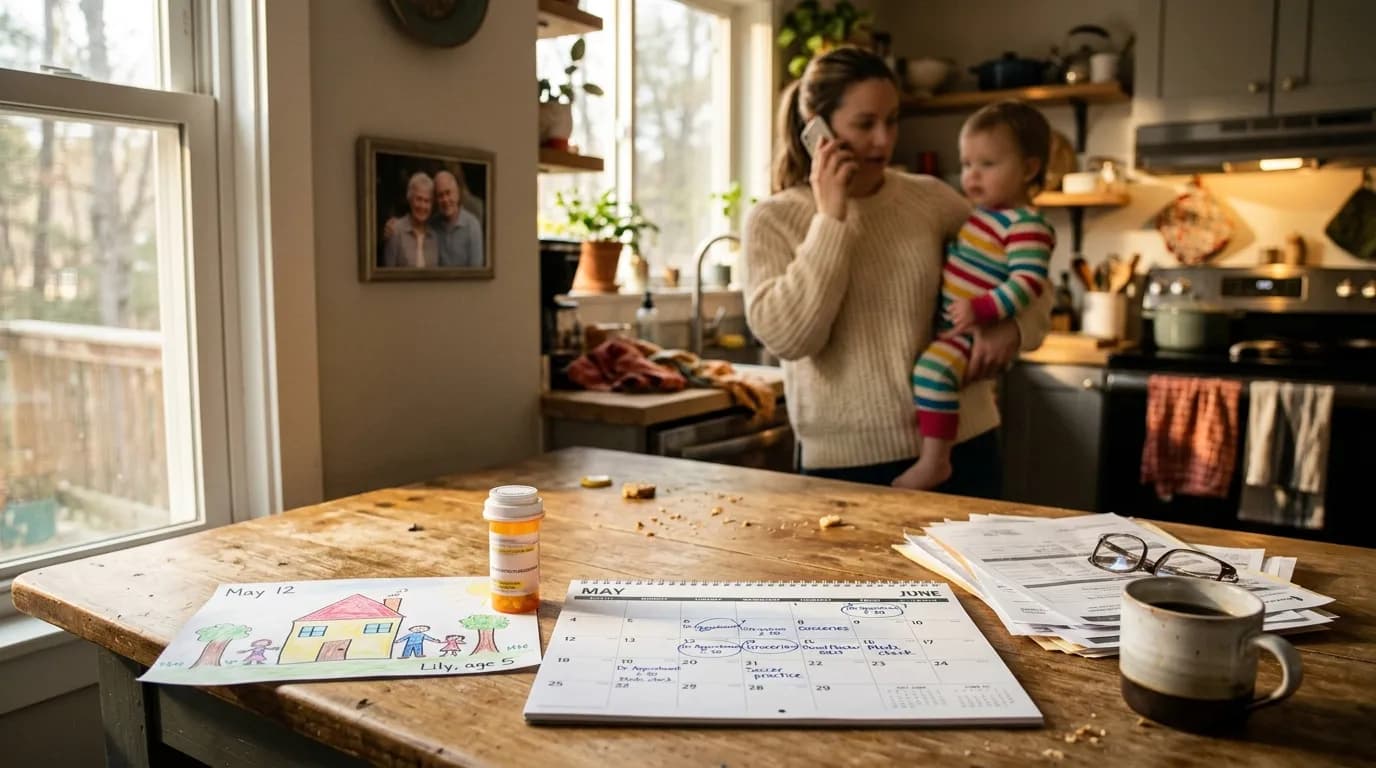
Meanwhile, you're juggling a full-time job, coordinating three doctors, tracking seven medications, fielding calls from siblings who live out of state, and trying not to cry in the pharmacy parking lot.
The truth is that caregiver burnout isn't a personal failure — it's a structural one. Our healthcare system offloads enormous responsibility onto family members with zero training, zero compensation, and zero backup. A 2025 Cleo survey of more than 12,000 people found that over half of adult caregivers and sandwich generation members are at clinical risk of burnout. That's not a self-care problem. That's a system problem.
As Daughterhood founder Anne Tumlinson wrote about the myth of self-care in caregiving: telling an overwhelmed caregiver to "take time for themselves" without addressing the impossible workload is like telling someone drowning to just breathe.
The Sandwich Generation Is Being Crushed
Nearly half of adults aged 40 to 59 are simultaneously caring for children and aging parents, according to Pew Research. They're called the "sandwich generation," and the numbers paint a devastating picture:
- 20 to 30 hours per week spent on caregiving duties — the equivalent of a part-time job
- 64% also hold full or part-time employment on top of caregiving
- 87% report stress and anxiety at some point, with more than half experiencing it weekly
- One-third say their mental health has gotten worse
The financial toll is just as brutal. Caregivers drain savings accounts, turn down promotions, reduce work hours, and in many cases leave the workforce entirely. A recent Baltimore Sun investigation found that eldercare is now one of the fastest-growing financial burdens for American families — and it falls hardest on the people who can least afford it.
The Guilt Trap
Perhaps the cruelest part of caregiver burnout is the guilt that comes with it. On Reddit's r/AgingParents and r/CaregiverSupport communities, the same confession appears again and again: "I don't want to do this anymore, and I feel terrible for feeling that way."
One caregiver wrote about caring for their mother with dementia for seven years before reaching a breaking point. Another described living with their 92-year-old mother for five years, watching their savings dwindle, and being told their help wasn't valued — all while a sibling who stops by occasionally gets offered payment.
These aren't edge cases. They're the norm. And the guilt is compounded by a culture that celebrates caregiving sacrifice while offering nothing in return.
Linda Burhans, a caregiving advocate and blogger, writes powerfully about guilt as a constant companion in caregiving: "Do you often think about the things you should have done, could have done, and would have done?" For many caregivers, the answer is always yes — and the weight of that never lifts.
What Actually Helps (It's Not What You Think)
Real burnout prevention doesn't start with scented candles. It starts with systems.
Get organized before the crisis. The single biggest stress amplifier is scattered information. Medications in one place, bills in another, doctor's notes lost in a text thread, emergency contacts buried in a junk drawer. When everything lives in one place — a shared digital hub that your whole family can access — you stop hemorrhaging mental energy on the logistics.
Distribute the load. Sibling inequality is one of the most documented patterns in caregiving. One person (often the one who lives closest or is the most responsible) shoulders 80% of the work. Break this pattern with shared task lists, transparent tracking, and clear accountability. When everyone can see what needs to be done, it's harder for anyone to hide.
Accept that "good enough" is enough. Perfectionism is a burnout accelerator. You don't need to cook from scratch every night. You don't need to attend every appointment in person. You need to sustain this for years, and that means conserving your energy for what matters most.
Get help before you need it. Contact your local Area Agency on Aging. Look into respite care programs. Explore whether your state offers paid family leave. Don't wait until you're in crisis — the resources are harder to find when you're already drowning.
You Deserve Care Too
Here's the thing nobody tells you when you become a caregiver: your health matters just as much as theirs. Not as a platitude on a wellness blog, but as a practical reality. If you burn out, everyone suffers. If you get sick, the whole system collapses.
Caring for yourself isn't selfish. It's the most important thing you can do for the person you love.
And if you're looking for a way to take back some control — to stop managing your parent's entire life out of a WhatsApp group chat and a pile of sticky notes — know that tools exist now that can help. The right caregiver platform can be the difference between drowning in logistics and actually being present for the moments that matter.
Because you became a caregiver out of love. You shouldn't have to lose yourself in the process.
Managing care for an aging parent?
TendTo helps families coordinate medications, bills, appointments, and documents in one shared dashboard.
Start Free